Guide · 7 min read · · by Arjun Jhukal
Website or mobile app for your business in Nepal? An honest guide
Most businesses that ask for an app need a fast website first. Some really do need an app. Here is how to tell which one you are — before you spend lakhs.
"We want an app" is one of the most common requests I hear from businesses in Kathmandu. Often what the owner means is "we want customers to find us and order easily on their phones" — and a fast mobile website does that for a fraction of the cost. But some businesses really do need an app. This guide helps you decide.
What a website does better
- Found on Google. Nobody searches the app store for "birthday cake delivery Lalitpur". They search Google, and Google shows websites.
- Nothing to install. A customer taps a link from Facebook, Instagram or WhatsApp and is ordering in seconds. Every install step loses people.
- One version for everyone — Android, iPhone and computer.
- Cheaper to build and change. One codebase, updates go live instantly, no app-store review.
What an app does better
- Daily use. Banking, wallets, ride-hailing, food delivery — things people open many times a week.
- Push notifications that reliably reach people who have installed the app.
- Phone hardware — camera scanning, background location, offline work, Bluetooth devices.
- A home-screen icon that keeps you in front of loyal customers.
A quick test
- Will a customer use it at least weekly? If not, they will not install it.
- Does it need the camera, location or offline use in a way a browser cannot do?
- Do you already have customers who come back on their own?
Three yeses: consider an app. Otherwise, build a fast mobile website first, and add an app later if customers ask for one.
What each costs in Nepal
- A business website: roughly NPR 15,000–1,50,000; an online store NPR 1,00,000–3,00,000 and up. See website cost in Nepal.
- A simple mobile app (Android and iPhone, one codebase): often NPR 2,00,000–6,00,000.
- An app with its own backend, payments and admin panel: NPR 5,00,000–15,00,000 or more.
- Running costs: app-store developer accounts (Google Play one-time, Apple yearly, both paid in US dollars), server costs and updates for new phone versions every year.
These are 2026 market ranges in Kathmandu, not a quote. An app always needs a backend and usually an admin panel too — the app itself is only the part customers see.
The middle path: a website that behaves like an app
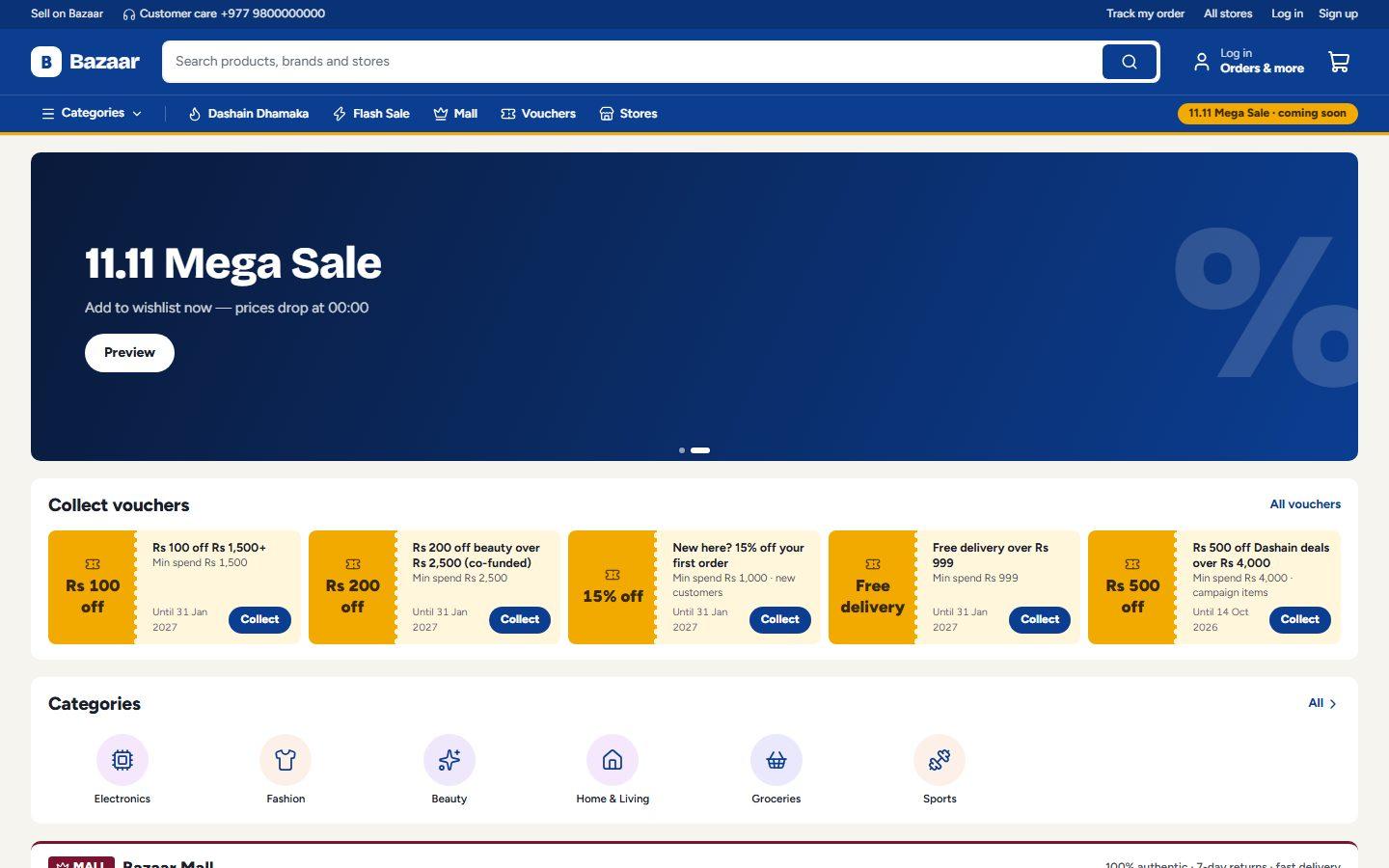
A modern website can be added to the home screen, open full-screen, remember the customer and work quickly on mobile data — often called a progressive web app. For many shops, restaurants and service businesses, this gives most of the app experience with none of the app-store cost. Every store I build on Next.js is designed phone-first, like Kapda and Bazaar, with eSewa and Khalti checkout that works in the mobile browser.
If you do need an app
Build the backend and admin panel so the website and the app share them. Then the app is a second screen on the same system, not a second system. That is how the platforms I build are structured: one Node.js API, and as many front ends as the business needs.